
Your Cart is Empty
WELCOME TO DARLING and COMPANY


Last Updated: November 17, 2026
Quick Summary
Build an accessory collection by auditing what you already own, then buying gradually in a set order: a daily bag, one versatile piece of jewelry, a scarf or belt, and a statement piece last. Test every purchase against three outfits you already own, and pick one primary metal and one accent to stay consistent.
An accessory collection is a small, chosen group of finishing pieces, such as bags, jewelry, and scarves, that you rotate on purpose instead of buying on impulse.
That definition matters. Most people own plenty of accessories; few own a collection.
A collection has a point of view, repeat wearers, and pieces that work together and stand alone.
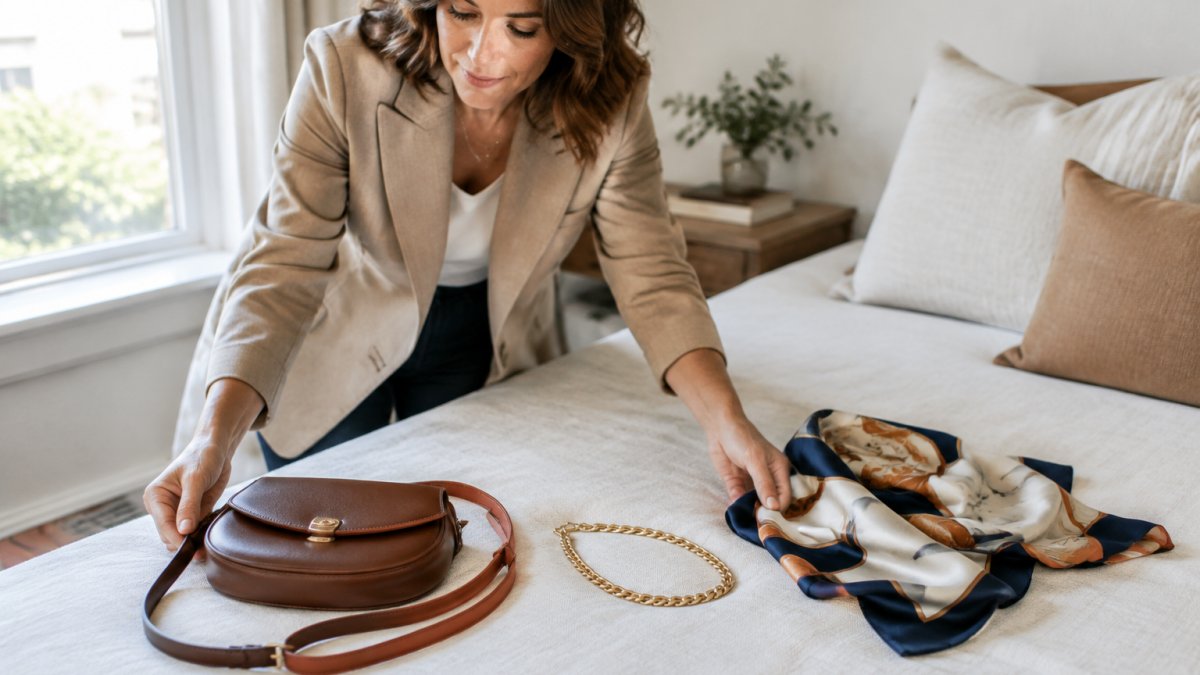
So before you shop, get honest about what you already have. Empty your drawer. Lay everything on the bed. Count what you actually reach for.
Count these as core collection pieces:
Skip these. They are not a collection:
The test is simple. If a piece never leaves the house, it is clutter, not collection.
Choosing accessories comes down to three filters: your daily life, your existing clothes, and your gut reaction in the mirror. The gap most guides leave is the method in the middle, how to test a piece against your wardrobe before you pay for it.
Start with your week. If you spend most days in blazers, a structured bag earns its keep; if you live in denim, a softer shape and a bold scarf get more wear.
Then look at your palette. Pull out five favorite outfits and note the dominant color, the metal on your hardware or jewelry, and the formality level.
Finally, trust the mirror test. If you have to talk yourself into a piece, it will sit in the closet.
If understated style is your goal, it helps to see how quieter pieces are made and finished. Our guide to indie luxury bag brands for understated style shows what to look for in craftsmanship and shape.
Most shoppers buy an accessory because they like it in isolation, then discover it fights everything they own. Reverse the order with a short compatibility test.
Running this test tends to lead to fewer purchases that get worn more often, because each purchase is anchored to outfits that already exist.
Run every piece through these three questions:
A piece that passes all three is a keeper. A piece that passes two is a maybe. A piece that passes one is a no.
Watch out: the mirror test is the easiest one to cheat. If you are imagining a more polished, more social, more adventurous future you rather than the person who actually gets dressed tomorrow morning, you are buying for the fantasy, not the wardrobe.
The smartest way to build a jewelry collection is to buy fewer, better pieces and layer them, rather than chasing sets.
Here is the order we recommend:
Metals matter. Pick one primary metal and one accent, then stay consistent. Mixing everything at once reads as noise, not style.
Vintage and estate pieces stretch a budget further and add history. Check clasps, prongs, and chain links before you buy.
Here is the order we recommend for building a jewelry collection.
| Step | Piece to add |
|---|---|
| First | One everyday chain in a metal you love |
| Second | One pair of studs or small hoops |
| Third | One statement piece, such as a bold ring or cuff |
| Fourth | One sentimental or vintage find |
Building gradually beats one big splurge. You learn what you actually wear between purchases and avoid five lookalike bags.
Use this sequence as your roadmap:
A common mistake is buying the statement piece first. It feels exciting, but it gets the least wear. Build the base, then add drama.
Versatile accessories win because they show up in more outfits, which lowers your real cost per wear. A trend piece might get three outings.
A single black leather crossbody works with jeans, a blazer, a dress, and travel, four jobs from one piece.
Trend pieces have their place. Buy them cheap, wear them hard, and let them go. But the backbone of your accessory collection should be pieces that flex.
Before any purchase, build three outfits around the piece in your head. If you cannot, it does not belong in your collection.
Try this exercise:
If you need a bag that handles errands and evenings without a swap, our guide on which phone crossbody bag is best for daily errands walks through the practical details.
Statement bags belong at the top of a finished collection, not the start.
The trick is restraint everywhere else. Pair a dramatic bag with a plain coat and quiet jewelry. Let one piece speak.
At Darling and Company, each bag is designed and handcrafted in the USA as a functionally artistic piece, with slight variations that make yours one of a kind.
If you are shopping for an occasion, our roundup of unique handbags for formal events covers seven statement picks worth considering. And when you are ready to see the full range, you can browse all bags to find the shape and finish that suit you. Readers drawn to a distinctive wooden piece often start with our wood box bags.
Cost per wear is the only price that matters. Divide the price by the number of times you expect to wear or carry the piece. A bag you carry weekly for two years beats a cheap trend buy every time.
The formula is simple: price divided by estimated wears. The hard part is estimating wears honestly.
Illustrative example: a $180 crossbody carried four days a week for two years is roughly 416 wears, or about $0.43 per wear. A $40 trend bag carried twice a month for a year is 24 wears, or about $1.67 per wear. The cheaper bag costs nearly four times as much per outing. Run the same math on jewelry, scarves, and belts before you buy, and the "expensive" piece often turns out to be the cheaper one.
Watch out: cost-per-wear math only works if the wear estimate is honest. If you have owned three similar bags and rotated none of them, a fourth will not magically get weekly use.
Plan your spending in tiers, and fund them in order:
Adjust to your life, but keep the order: base first, drama last.
Shop with care along the way. Buy the boring, useful piece before the exciting one.
A few concrete habits keep the budget honest:
Watch out: discount hunting can flip into hoarding fast. A markdown is only a saving if the piece passes the three-outfit test. Set a number before you walk in, and leave when you hit it.
Care is what separates a collection from a pile. Store bags stuffed with tissue in dust bags, keep jewelry dry and separated, and fold scarves flat to avoid creasing.
A simple routine keeps pieces looking new:
A loose clasp fixed early can save a piece from becoming a loss.
Your accessory collection only works if every piece earns its place, and that starts with choosing bags you will actually reach for.
There's no magic number, but a workable rule is to aim for pieces you wear at least once a month. Most people do well with two or three everyday necklaces, one or two statement pieces, a neutral belt, a scarf or two, and two or three bags covering different occasions. If an item hasn't been worn in a year, it's taking up space a better-fitting piece could use. Build toward that number slowly rather than buying to hit a quota.
Start with your wardrobe's dominant colors and metals, then buy accessories in those tones first. A black or tan leather crossbody, a gold or silver chain you wear daily, and a neutral scarf will work with most outfits you already own. When you're learning how to choose accessories, test each piece against three existing outfits before buying. If it only works with one, it's a statement piece, not a versatile one, and it belongs later in your collection.
The usual guidance is to let one piece lead. If you're carrying a bold statement bag, keep jewelry and belts quiet. If the necklace is the focal point, choose a simpler bag. This keeps an outfit from feeling like a costume and makes each statement piece read as intentional. Darling and Company's Rowan Black Croc Clutch at $35 is an easy way to test a bolder look without committing a large budget to it.
Write down the three words you want your look to convey, then filter every purchase through them. If your words are classic, textural, and understated, a smooth leather Camden Bag at $250 fits; a loud novelty piece probably doesn't. Building an accessory collection around personal style means saying no to good pieces that aren't yours. Review your closet every season and note which accessories you actually reached for, then buy more in those categories.


