
Your Cart is Empty
WELCOME TO DARLING and COMPANY


Last Updated: October 14, 2026
A handcrafted accessory is a wearable object made in small batches by a skilled maker, where the finishing work is done by hand rather than by an assembly line.
Mass-produced bags are engineered for volume. A handcrafted bag is engineered for the person carrying it.
Below, we break down the benefits, the craftsmanship, and the math that most buyers never run.
Buying American-made handbags keeps the money, the craft, and the accountability close to home. When a bag is designed and finished in a domestic studio, the maker is reachable, the standards are visible, and the supply chain is short enough to trace.
Here are the benefits buyers tell us matter most:
That last point is not just feel-good framing. A short supply chain is also an easier one to verify, which matters when you want proof behind an ethical claim.
Handcrafted bag craftsmanship is the sum of many small decisions: which materials are cut, how the trim is finished, how the hardware is protected, and how the interior is lined. None of these are dramatic on their own.
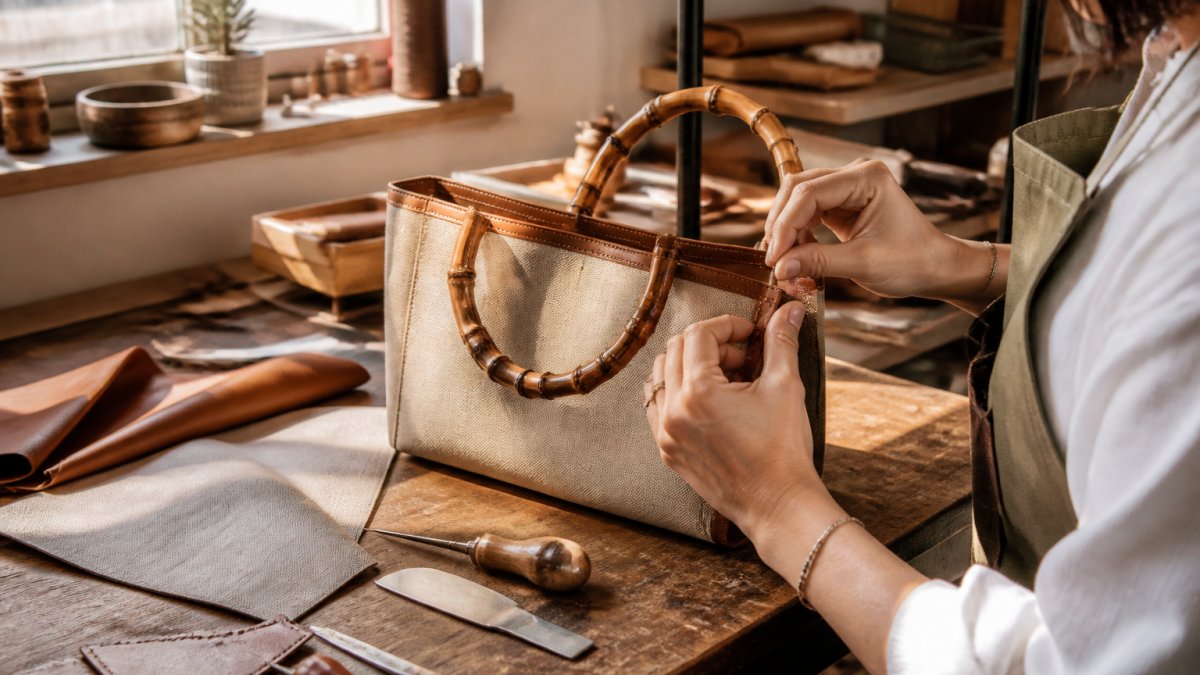
Start with the materials, then look at the finishing. A bag built on quality materials still fails if the finishing is rushed, so judge both.
What to look for:
A common mistake is judging a bag by its exterior alone. The interior and the underside of the hardware are where corners get cut, and they are the first places to fail.
Choosing a quality handbag before you buy comes down to five checks you can run in minutes, in person or from detailed product photos. Run them in order, and you will separate a genuine handcrafted piece from a mass-produced look-alike.
| Check | What to Look For | Why It Matters |
|---|---|---|
| Materials | Substantial leather, canvas, or tweed | Thin materials crease and crack early |
| Hardware | Protected clasps, hinges, purse feet | Unprotected metal tarnishes and pits |
| Interior | Lined, with pocket and mirror | Raw interiors fray and snag contents |
| Finishing | Hand-set trim, clean edges | Glued trim lifts within months |
| Construction | Reinforced handle attachment | Weak attachment is the first failure point |
If a seller cannot tell you where a bag is made or how it is finished, treat that as an answer. The Federal Trade Commission guidance on made-in-USA claims sets out how "Made in USA" claims must be substantiated, which is a useful standard to hold any brand to.
Cost per wear is the purchase price divided by the number of times you actually carry the bag. It is the single most useful number in this decision, and almost nobody calculates it.
The formula:
Cost per wear = Purchase price ÷ Total wears over the life of the bag
A worked example using realistic carry patterns:
| Mass-produced bag | Handcrafted bag | |
|---|---|---|
| Purchase price | $60 | $400 |
| Carries per week | 3 | 3 |
| Years of service | 1.5 | 8 |
| Total wears | ~234 | ~1,248 |
| Cost per wear | ~$0.26 | ~$0.32 |
At first glance the cheap bag wins. Now add the second purchase.
The three variables that decide the outcome:
Run it yourself before you buy. Estimate how often you will realistically carry the piece, not how often you wish you would.
Long-term ownership is a practice, not a purchase. A handcrafted bag rewards a small amount of routine care with years of additional wear, and most of that care costs nothing. What follows is material-specific guidance, because leather, canvas, tweed, and bamboo fail in different ways and need different handling.
Stuff the bag with acid-free tissue or a clean pillowcase so it holds its shape between wears, and stand it upright. Store it in its dust bag, not a plastic bin. Rotate bags rather than carrying one every day, leather and fabric both recover from compression when given a day off.
Repairability is the real durability feature of a handcrafted bag. A bag that can be fixed is a bag you keep.
Handcrafted accessories are an investment in use, not a financial instrument. Most handbags, handcrafted or not, do not reliably appreciate, and buying one expecting a return is a mistake.
Where handcrafted pieces do hold value is in longevity, wear frequency, and the fact that a one-of-a-kind design does not get discounted into oblivion the moment a trend passes.
If resale matters to you, buy what you will genuinely carry. A bag that stays in the closet has no cost-per-wear advantage and no resale story.
The right handcrafted accessory is the one you actually reach for: durable enough for daily wear, distinctive enough to start a conversation, and made well enough to repair rather than replace. At Darling and Company, every bag is designed and handcrafted in the USA as a functionally artistic statement piece, from the Gilded Croc Bag (Black) with its acid-protected hardware and velvety lined interior to the Darling Thoroughbred Bag and the Van Gogh Irises Bag, each made to order with slight variations that make it uniquely yours.


Shop bags at Darling and Company and invest in a piece that earns its cost every time you carry it.
They often do, because the construction decisions favor longevity. Handcrafted bags are built with reinforced stitching, hardware protected against tarnish, and materials chosen for wear rather than minimum cost. A mass-produced bag is assembled at speed, and its weak points (strap anchors, lining seams, coated hardware) tend to fail first. With basic care, a hand-finished bag can stay in rotation for years, and many can be repaired instead of replaced. Longevity still depends on how you use and store the bag, not on the label alone.
They reduce waste in a few concrete ways. Small-batch and made-to-order production means fewer unsold units headed for clearance or landfill, and artisan workshops typically cut and finish materials to order rather than overproducing. Repair and re-finishing extend a piece's useful life, which is the single biggest sustainability lever in fashion. That said, sustainability claims vary by maker. Ask where materials come from, how the piece is finished, and whether the studio offers repairs. Verifiable answers matter more than a general eco label.
Start with the details you can inspect. Check stitch density and consistency along the strap anchors and top edge, where stress concentrates. Look at hardware: acid-protected or solid metal resists tarnish better than thin plating. Open the bag and examine the lining, pocket, and seam finishing. On a hand-finished piece, slight variations between units are normal and often a sign of handwork. Ask the maker directly whether the bag is made to order, what the materials are, and whether repairs are offered. A clear answer is itself a quality signal.
It depends on how you measure value. If you calculate cost per wear, a $625 handcrafted bag worn twice a week for three years costs roughly $2 per wear, which compares well with replacing a cheaper bag every season. What you are paying for is hand-finishing, materials selected for durability, small-batch production, and a design you will not see on everyone else. If resale profit is your goal, handcrafted accessories are not a financial instrument. If daily use, uniqueness, and longevity are the goal, the math often favors them.


