
Your Cart is Empty
WELCOME TO DARLING and COMPANY


Quick Summary
Handcrafted bags are shaped largely by hand by skilled makers, while designer handbags carry a fashion house's name that often shapes the price more than the making does. Handmade construction alone does not guarantee durability, so materials and craftsmanship matter more than method.
Last Updated: November 1, 2026
Handcrafted bags and designer handbags sit under the same heading in most shops, but the words describe different things. A handcrafted bag is shaped largely by hand, with skilled makers cutting, stitching and finishing each piece. A designer handbag carries a fashion house's name, and that name often shapes the price more than the making does. Darling and Company, which handcrafts its bags in the USA, sits on the handcrafted side of that divide.
The label "handmade" is also less precise than it sounds. Handmade construction alone does not guarantee durability; the quality of the craftsmanship and materials matters more than the method. Not every luxury handbag is handmade either. Some luxury houses rely on skilled artisans, while others depend on different production methods.
Market data points to strong demand for both.
Materials explain much of the price gap.
Look at what the Darling and Company range actually uses. The Rowan Black Croc Bag combines black crocodile-embossed genuine leather with black patent leather, while the Lauren Bag in Black uses genuine smooth black leather with an ivory caviar leather band. The Atlas Tote in Navy/Spa Blue is made from caviar leather.
Ask three questions when you compare leathers:
Machine-made bags are not inherently worse. The difference often shows up in the details: how the edges are finished, how the corners hold their shape, and whether the interior is lined with care.
Darling and Company's listings describe the hand-finished work directly. The What a Croc in Blue Bag and Gator Glam Bag are both made to order and hand-finished in the design studio, and each may vary slightly from the photographs. Varied artistic details are subject to the designer's discretion, so expect minor differences from one bag to the next.
Interior finishing matters too. The two gator-embossed pieces include a velvety liner, an interior pocket and a small mirror. The Atlas Tote adds a detachable zippered pouch, plus zippered and split open pockets.
A repeatable inspection is more useful than a single glance: work through the bag in the same order every time, and judge each zone against a specific standard rather than a general impression.
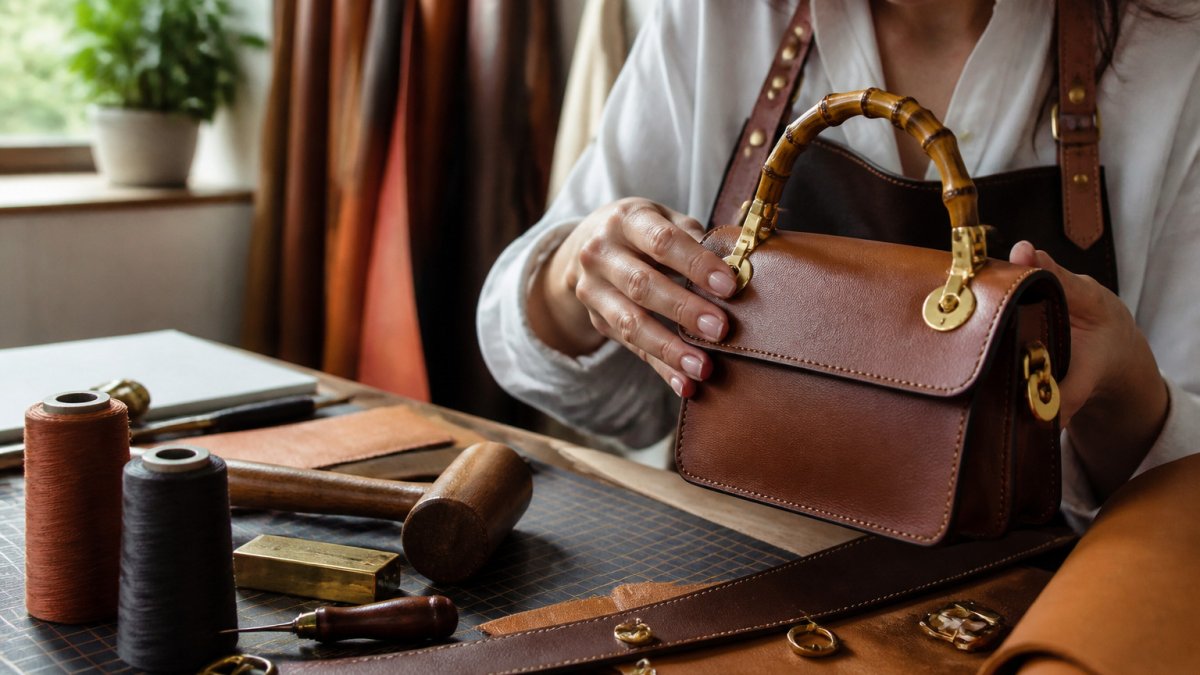
1. Seams and stitch density. Look at the main seam along the gusset and the strap attachment. Stitches should be the same length, sit at an even distance from the edge, and show no skipped or doubled points. On a handcrafted bag, slight variation is normal; a wandering stitch line or loose tension is not. Ask the seller for the stitch count per inch if you are comparing online.
2. Edge finishing. Run a fingernail along the cut edge of the strap and the top opening. A finished edge is sealed, painted, or burnished and feels smooth; a raw edge will feel fibrous and may shed. Edge paint should wrap the cut cleanly without bubbles or cracks at the bend.
3. Hardware and stress points. Open and close every zipper and clasp several times. Hardware should move smoothly, feel solid rather than hollow, and be anchored through leather or a reinforced patch, not just the lining. Check the strap anchors and the base corners, where load concentrates. Rivets should sit flush; screws should be tight. On the Gator Glam Bag, for example, the listing specifies acid-protected hardware and gold riveted suede trim, which tells you what to inspect rather than leaving it to guesswork.
4. Lining and interior attachment. Turn the bag inside out if you can. The lining should be attached cleanly at the top edge with no loose threads or glue visible, and pockets should be stitched through to a backing so they do not sag. The two gator-embossed pieces include a velvety liner, an interior pocket and a small mirror, while the Atlas Tote adds a detachable zippered pouch plus zippered and split open pockets.
5. Shape retention. Set the empty bag on a table and look at the corners and the base. A well-constructed bag holds its silhouette when empty; a flimsy one collapses at the corners or bulges at the base. Press gently on the base panel, it should feel reinforced, not spongy.
6. Leather surface. Tilt the bag toward a light source. Full-grain leather shows natural grain variation and small healed scars; embossed leather (like the croc pattern on the Rowan Black Croc Bag) should have a consistent, deeply pressed pattern with no thin or shiny spots where the finish is wearing through. The listing should name the grade, full-grain, top-grain, or bonded, and the finish.
Most comparisons stop at the purchase price. The more useful question is what a bag costs you per year of use, and whether it can be maintained rather than replaced. That framing is where handcrafted and designer bags diverge most, and where most buying guides say nothing.
Durability depends on materials and construction, not on the label. A well-built bag from any source can last years with regular use, while a poorly finished one may fail within months. The failure points are predictable: strap anchors, zipper tape, edge paint at the bend, and the base corners. Inspect those first, then plan care: store bags out of direct sun, keep them dust-protected, and avoid overloading the strap.
Cost per year of use. Divide the price by the number of years you realistically expect to carry the bag, then add upkeep. For a practical guide to how long handcrafted leather bags actually last, see how long handcrafted leather bags actually last. A bag at a lower entry price that lasts two seasons can cost more over time than a higher-priced piece that serves for a decade. Darling and Company's range runs from $35.00 for the Rowan to $625.00 for the What a Croc in Blue and Gator Glam bags, so the math changes sharply by piece. Run the numbers for the bag you are actually considering rather than for the brand as a whole.
Repairability and warranty. Ask three questions before you buy: Can the maker replace a strap or re-stitch a seam? Is there a warranty, and what does it cover, hardware, stitching, or only manufacturing defects? Who pays shipping for a repair? A handcrafted maker who answers these in writing is offering something a mass-produced label often cannot: a named point of contact for upkeep. Designer houses vary widely here, so read the policy rather than assuming a luxury price buys service.
Resale value and authentication. We cannot tell you what a Darling and Company bag will fetch on the secondhand market, since no resale data for these bags is available. If resale matters to you, treat a handcrafted bag as something you enjoy and wear, not as a store of value, and if you buy designer, keep the receipt, dust bag, and authenticity cards, because provenance is what authenticators rely on. To see which factors determine what a luxury handbag is worth later, read which factors determine a luxury handbag's worth.
The article compares what each bag costs over its useful life, with the key price points and figures it cites.
| Item | Value | Note |
|---|---|---|
| Rowan Black Croc Bag | $35.00 | Entry price, lowest in range |
| Atlas Tote, Navy/Spa Blue | $95.00 | Professional daily wear |
| Lauren Bag in Black | $125.00 | Includes crossbody chain |
| Gator Glam Bag | $625.00 | Made to order |
| What a Croc in Blue Bag | $625.00 | Made to order |
Handcrafted bags suit buyers who care more about individual construction and a distinctive look than brand recognition.
Match the bag to the situation:
The Lauren Bag in Black includes a crossbody chain and is priced at $125.00. For a bold, one-of-a-kind piece, the What a Croc in Blue Bag features a gold gator bauble and gold riveted suede trim.
If you are deciding between Darling and Company's core bags, start with the one that fits your routine. The Rowan Black Croc Bag, at $35.00, includes a crossbody chain and a black bamboo handle. The Lauren Bag in Black is priced at $125.00 and includes a crossbody chain. The Atlas Tote in Navy/Spa Blue is priced at $95.00.


Before you buy, compare the materials, dimensions and daily-use needs against the checklist above. Then choose the bag you will actually carry. For a closer look at any piece, you can view the Rowan Black Croc Bag directly and check its details against the other options.

A handcrafted bag is made largely by hand by a small team or individual artisans, often to a specific design or with custom choices. A designer handbag carries a fashion house label and is often produced in larger runs, sometimes with machines and sometimes in factories across several countries. The label itself does not tell you how a bag was made, so check the construction details, the materials and whether the maker says where and how each bag is produced.
Not automatically. Quality depends on leather grade, stitching density, edge finishing and hardware, and a well-made handcrafted bag can outlast a poorly made designer piece. Designer houses do produce excellent bags, and some handmade bags have weak construction. Judge each bag on the same checklist of materials, construction and finishing rather than on whether it is handmade or branded.
Prices vary widely. Darling and Company's current bags range from $35.00 for the Rowan Black Croc Bag and $95.00 for the Atlas Tote to $125.00 for the Lauren Bag in Black, with the made-to-order gator bags at $625.00 each. Entry-level designer bags are also expensive, and part of a designer price reflects brand marketing and logo premium rather than materials alone. Compare the materials and construction you receive per dollar, not the label.
Check the leather type and whether it is genuine, examine the stitching for even spacing and no loose threads, look at how the edges are finished, and test the hardware for smooth clasps and secure attachment points. Ask whether the bag is made to order and whether slight variations are expected, since handmade pieces can differ from photos. Look for a clear description of dimensions, materials and care instructions from the seller.


