
Your Cart is Empty
WELCOME TO DARLING and COMPANY


Last Updated: October 21, 2026
Handcrafted USA leather bag durability is determined less by the leather's origin story and more by how the bag is assembled. A beautiful hide sewn with weak thread and unreinforced seams will fail long before a modest hide built with proper construction. That distinction matters because most buyers shop by material name alone, then wonder why an expensive bag starts separating at the strap within a year.
At Darling and Company, we build every piece around that principle: the leather is the visible layer, but construction is what decides whether you carry the bag for a season or a decade. Below, we break down the failure points, the leather grades, the care routines, and the ownership math that separate a lasting bag from a disposable one.
Nearly every bag failure traces back to one of three places, and each has a specific mechanism worth understanding before you buy.
Seams. Thread fails for two reasons: it is too thin for the load, or the stitch type distributes stress poorly. A lockstitch, the most common machine stitch, uses two threads that interlock inside the seam and will not unravel from a single broken stitch, but it concentrates stress at each needle hole.
Stress points. Strap attachments, handle anchors, and the top edge of the bag carry the most load and fail first. Reinforcement takes several forms: bar tacks (dense zigzag stitching that locks a seam end), box-X stitching (a square with an X through it at strap anchors), rivets (solid brass or copper, not plated), and double stitching along load-bearing seams.
Hardware. Hardware fails when plated zinc or lightweight alloy is used instead of solid brass or steel, causing clasps to snap or finish to flake. Solid brass is heavier and develops a patina rather than flaking; plated zinc can look identical at purchase but sheds its finish at contact points.
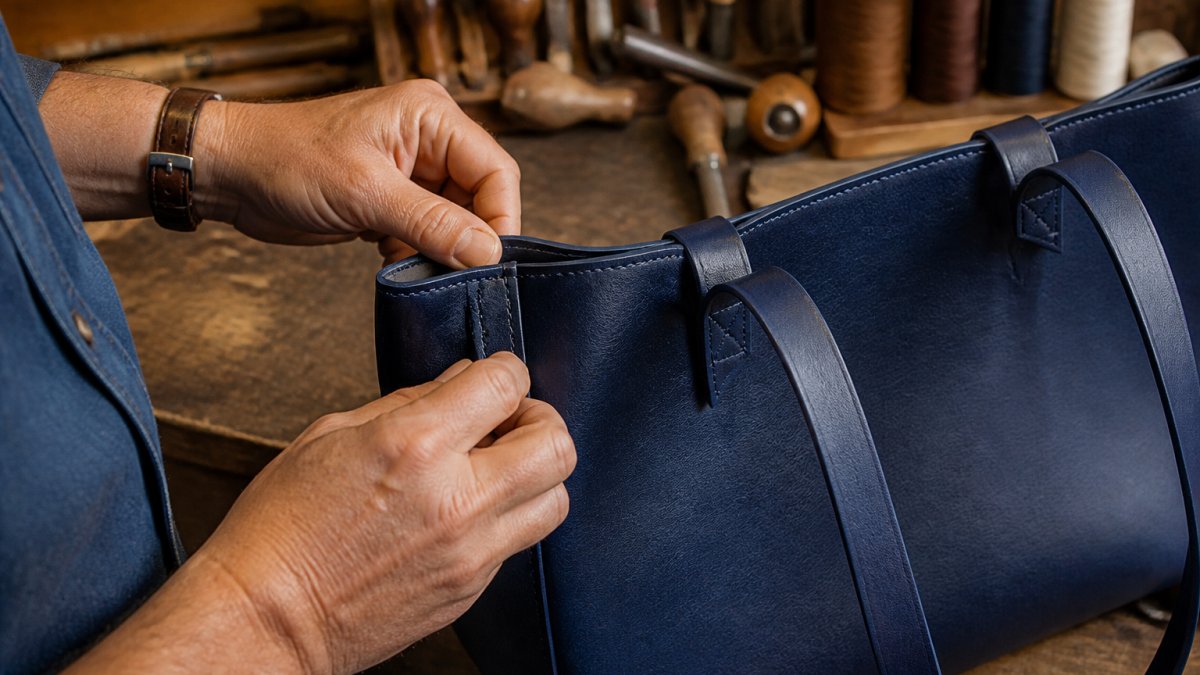
A common mistake is judging a bag by the outside leather while ignoring the inside. Flip the bag open and look at the seam allowance, the lining attachment, and how the strap connects. That is where the real quality lives.
The phrase "handcrafted in the USA" describes where and how a bag is made, not a durability guarantee. Two disclosures matter. First, domestic sourcing versus domestic assembly: a bag can be assembled in the United States from imported leather, or made from domestic hides and assembled abroad. Neither is inherently more durable, but the distinction tells you which steps the maker controls. Second, which steps happen in the United States: cutting, stitching, edge finishing, and hardware attachment are the steps that most affect durability, so a maker who performs those steps in-house has more control over seam quality and stress-point reinforcement than one who outsources them.
Production location relates to quality through consistency and accountability, not through geography itself. A domestic workshop that inspects every seam and stands behind its construction is more likely to catch a weak bar tack than a high-volume overseas line, but the reverse is also possible. The practical takeaway: ask which steps are done in-house, whether the maker discloses leather sourcing, and whether the construction is backed by a repair policy. Those answers tell you more about durability than the phrase on the label.
A well-made leather bag lasts 10 to 20 years with regular care, and a poorly constructed one can fail in under two years. The range is wide because lifespan depends on leather grade, construction quality, and how the bag is used and stored.
Full-grain leather, properly conditioned and kept out of prolonged moisture, develops a patina and holds structural integrity far longer than corrected-grain or bonded leather. Bags used daily for work and travel will show wear sooner than occasion bags, but wear is not the same as failure. Scuffed edges and a darkened handle are cosmetic. Torn stitching and cracked leather at fold points are structural.
The honest answer: leather bag durability is a maintenance relationship, not a fixed number.
High-quality leather bags show tight, even stitching, reinforced stress points, solid metal hardware, and leather with a visible natural grain rather than a uniform plastic surface. Those four signals tell you more than any label.
Check these in order:
Full-grain leather is the outermost layer of the hide, retaining the natural grain and the tightest fiber structure. It is the most durable grade and ages into a patina.
Top-grain leather has been sanded to remove imperfections, which produces a smoother surface but removes some of the strongest fibers.
Genuine leather is a legal marketing term, not a quality grade. It can describe leather made from split layers or reconstituted scraps, and it is the least durable of the three.
| Leather Type | Durability | Ages Into Patina | Typical Use |
|---|---|---|---|
| Full-grain | Highest | Yes | Heirloom bags, totes |
| Top-grain | Moderate | Limited | Structured bags |
| Genuine leather | Lowest | No | Budget accessories |
| Vegan/synthetic | Varies | No | Casual, low-wear |
Vegan and synthetic leathers avoid animal materials but generally cannot match full-grain leather's lifespan, and many peel or crack at flex points over time.
Leather bag care and maintenance comes down to three habits: clean gently, condition sparingly, and store properly. Most damage comes from over-cleaning and poor storage, not from under-care.
Wipe the surface with a dry or slightly damp cloth. Apply a leather conditioner two to four times a year, more in dry climates, working a small amount into the leather and buffing off the excess. Store the bag stuffed with tissue or a pillow to hold its shape, inside a breathable dust bag, away from direct sunlight and radiators.
For the Atlas Tote, with its reinforced bottom and interior pockets, keep the structure supported when stored so the base holds its shape.

Leather bag water damage is treatable if you act fast and avoid heat. Blot the excess with a dry cloth, then let the bag air dry at room temperature, stuffed to hold its shape.
Never use a hairdryer, radiator, or direct sunlight to speed drying. Heat pulls moisture out too fast and causes the leather to stiffen, shrink, and crack. Once dry, condition the leather to restore oils.
Light rain is generally manageable for finished leather. Prolonged exposure is the real risk, so treat water resistance as a matter of care, not a permanent guarantee.
Durability requirements shift with load, frequency, and weather exposure. A bag that survives client meetings may not survive a daily commute stuffed with a laptop, water bottle, and gym clothes. The practical way to match a bag to its job is to estimate three variables: average carry weight, days per week of use, and how often the bag is exposed to rain or sun.
School and daily carry. Expect 8 to 15 pounds on a typical day: a laptop, charger, notebook, water bottle, and lunch. At that load, the handle anchors and strap attachments take the most stress, so prioritize box-X stitching, bar tacks, and rivets at those points. A structured base matters because a bag that sags under load puts more tension on the seams.
Work and professional use. Loads are often lighter, 5 to 10 pounds, but the bag is carried frequently and set down repeatedly, so the base and corners take abrasion. Look for a bag that holds its shape under moderate weight, with secure closures and interior organization that keeps contents from shifting.
Travel. Travel combines the heaviest loads with the most weather exposure and the most handling by other people. A carry-on bag may hold 15 to 25 pounds and be lifted by the strap, set on floors, and exposed to rain. The Camden Bag, with its adjustable leather crossbody strap and antiqued gold rivet trim, is built for hands-free carry through airports and cities.

Match the bag to the load. A lightweight occasion bag pushed into daily heavy-duty service will wear faster than its construction deserves.
Cost per wear is the honest durability metric: divide the price by the number of days you actually carry the bag. A $250 bag carried 200 days a year for five years costs about 25 cents per wear. A $95 bag that falls apart in a year of daily use costs far more per wear despite the lower sticker price.
Repairability matters just as much. Leather bags can be re-stitched, re-lined, and re-conditioned by a skilled cobbler, which extends life well beyond the original purchase. Before buying, ask whether straps and hardware can be replaced and whether the maker stands behind the construction.
The challenge with any leather bag purchase is separating marketing language from construction truth. Look at the seams, the stress points, and the hardware, then care for the leather consistently and store it properly.
At Darling and Company, every bag is designed and handcrafted in the USA as a functionally artistic statement piece, built with reinforced construction and made to be carried, not shelved. Explore the Atlas Tote or the Lauren Bag in Black to see the construction details for yourself, and shop bags that are made to last.

Genuine leather bags can last anywhere from 5 to 15 years depending on the hide grade, construction, and care. Full-grain leather, the top layer of the hide, outlasts split or bonded leather because its fibers stay intact. Stitching quality and hardware matter just as much as the material: a bag with reinforced seams and solid metal hardware will outlast one with glued edges or plated zippers. Regular conditioning and prompt treatment of water exposure add years to the lifespan.
Leather bag durability comes from four things: full-grain hide, hand-sewn or reinforced stitching at stress points, solid hardware, and a reinforced bottom. Handcrafted bags often use heavier thread and double-stitch load-bearing seams, which mass-produced bags skip to save time. The bag's structure also matters: feet protect the base, and interior pockets distribute weight. A bag built this way handles daily wear far better than one assembled with glue and light thread.
Often yes, but not automatically. Handcrafted construction allows for tighter stitching, reinforced stress points, and better hide selection, all of which extend lifespan. Mass-produced bags cut costs with thinner leather, glued seams, and plated hardware that peels. The gap shows up fastest at handles and zippers. Check the stitching density and whether the bottom is reinforced before assuming a handcrafted label guarantees durability. Construction details tell you more than the marketing copy.
A light rain won't ruin a leather bag, but soaking it can cause water stains, stiffening, and cracking as it dries. Blot moisture immediately with a dry cloth and let the bag air dry away from heat. Never use a hair dryer or radiator, which speeds cracking. Condition the leather once it's fully dry to restore oils. For daily commutes in wet weather, treat the bag with a leather protector and store it in a dust bag when not in use.


