
Your Cart is Empty
WELCOME TO DARLING and COMPANY


Last Updated: October 26, 2026
Quick Summary
You can spot quality craftsmanship by checking tight, irregular leather grain, stitching of roughly 6 to 10 stitches per inch that sits flush, heavy solid hardware, and thin even edge paint that does not crack. Turn the bag inside out to confirm the lining is stitched in rather than glued.
Seventy percent of consumers say they will pay more for handmade goods of genuine quality, according to ACT Insurance's 2026 arts and crafts industry trends report. That number explains a lot about the current accessories market, and it also explains why "handcrafted" has become one of the most abused words in retail. At Darling and Company, we build every bag by hand, so we have a stake in this conversation. Knowing how to spot quality craftsmanship is the only real defense against paying artisan prices for assembly-line work.
Craft participation is widespread: Mintel's 2026 U.S. arts and crafts consumer report found that 73% of adults completed a crafting project in the past year. A public that makes things tends to recognize when something is made well. The U.S. craft and artisan sector is projected to reach $52 billion in value by the end of 2026, per Unite Worldwide's craft show industry statistics, which means more buyers will face the same question: is this actually well made, or just well marketed?
Below, we walk through the exact inspection points we would use on any bag, ours included.
High-quality leather shows tight, irregular grain, a supple hand, and edges that were finished rather than painted over. Quality craftsmanship starts with the hide, and no amount of stitching can rescue poor material.
Full-grain leather keeps the outermost layer of the hide, so you can see natural pores and variation across the surface. Corrected-grain leather has been sanded and stamped, which is why it looks suspiciously uniform. Run your thumb across the surface: genuine grain shifts and varies, while a printed pattern repeats identically. Smell matters too. Real leather smells earthy and slightly animalic; plastic finishes smell chemical.
Durability questions come up constantly, and they are fair. For a closer look at how handcrafted leather bags hold up over years of use, see our guide to handcrafted USA leather bag durability.
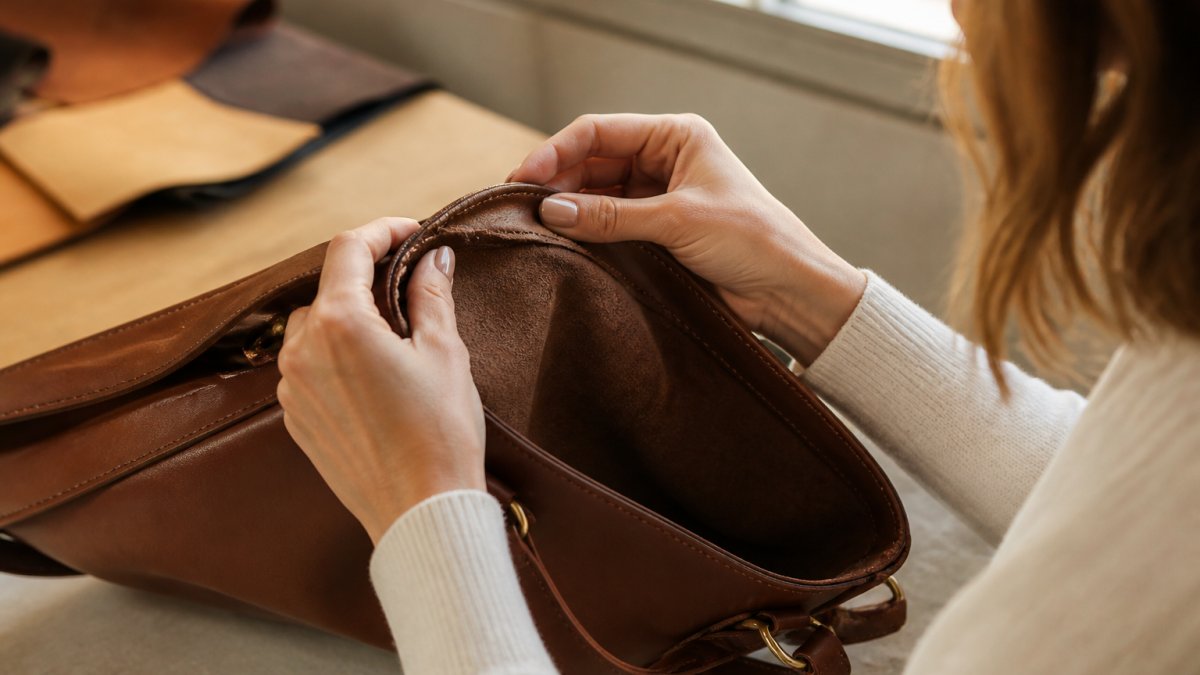
Good stitching is dense, even, and consistent: roughly 6 to 10 stitches per inch on a bag seam, with thread that sits flush rather than puckering the leather. Loose, uneven, or widely spaced stitches are the fastest tell of rushed construction.
Turn the bag inside out and look at the reverse side. On a well-made bag, the underside of the seam is nearly as tidy as the front. Loose thread tails, skipped stitches, or glue visible along the seam line all point to shortcuts. Check the thread itself: bonded nylon or polyester thread holds up to friction far better than cotton, which frays with daily carry.
A common mistake is judging stitching from arm's length. Get within a foot of the seam and follow it end to end. Irregularity hides in plain sight until you look closely.
Solid brass or stainless steel hardware feels heavy and cool, operates smoothly, and shows no seam where the piece was cast. Hollow, lightweight hardware that rattles or sticks is a sign of cost-cutting that will surface within months of daily use.
Open and close every closure several times. Zippers should glide without catching, and the pull should feel anchored rather than loose. Look at how hardware attaches: leather tabs or rivets that reinforce the connection last far longer than hardware screwed directly into a thin panel. On a bag with a chain strap, check the links for soldered closures. Open links stretch and eventually fail.
The FTC's Made in USA standard guidance is worth knowing here: an origin claim speaks to where a product was made, not to how well. Verify construction with your own hands rather than trusting a label.
Finished edges and a sewn-in lining separate handcrafted bags from mass-produced ones. Edge paint should be applied in thin, even layers with no cracking at the bend; a raw, unsealed edge will fray and peel within a season.
Look inside. A lining that is stitched into the bag, rather than glued at the top seam, signals a maker who expects the bag to be used hard. Interior pockets should be reinforced at stress points, and the base should carry structure, often a reinforced panel or feet, so the bag holds its shape when set down. Feet matter more than most buyers realize: they keep the leather off abrasive surfaces.
For a deeper look at how these construction choices affect longevity, read our practical guide to how durable handcrafted leather bags really are.
Use this checklist in order. It takes about five minutes in person and translates to photo requests if you are buying online.
| Check | What to Look For | Red Flag |
|---|---|---|
| Leather grain | Irregular pores, supple hand, earthy smell | Uniform printed pattern, chemical odor |
| Stitching | 6-10 stitches per inch, flush and even | Skipped stitches, loose tails, puckering |
| Hardware | Heavy, smooth-operating, soldered links | Rattles, sticks, open chain links |
| Edges | Thin even paint, no cracking at bends | Raw edges, thick paint, peeling |
| Lining | Stitched in, reinforced pockets | Glued at seam, thin fabric |
| Base | Reinforced panel or protective feet | Sagging, unprotected bottom |
When you are ready to apply the checklist in person, browse our leather bags.
Quality craftsmanship is a wardrobe strategy, not a one-time purchase decision. A bag built with tight stitching, solid hardware, and finished edges gets reached for daily and repaired rather than replaced, which is why it earns its place next to pieces with decades of heritage behind them.
The Strategic Entrepreneurship Journal study on potter Lucie Rie traced how material expertise accumulates over a maker's career and shapes what they can produce. That principle applies to what you buy: a maker who understands their material builds differently. For the fuller argument on why handcrafted accessories justify their cost, read our guide to investing in handcrafted accessories.
The real challenge is finding a bag that survives both daily wear and the scrutiny of a close inspection. That is what we build at Darling and Company: statement bags designed and handcrafted in the USA, each one unique with slight variations that come from handwork rather than a mold. Our bags feature reinforced bottoms and protective feet, finished interior pockets, and hardware chosen to hold up, from the Atlas Tote in Navy/Spa Blue to the bamboo-handled Millie Bag in Black. Get started with Darling and Company and carry a piece that rewards a closer look.
Start with the leather itself: full-grain hides show natural pores and irregularities rather than a uniform plastic surface. Then check the stitching, which should be tight, evenly spaced, and doubled at stress points. Look at the edges, which should be painted, burnished, or bound rather than left raw. Finally, open every pocket and feel the lining. A well-made bag is finished where nobody sees it, and that hidden work is the clearest signal of quality craftsmanship.
Stitch length should be consistent across the whole bag, with no wandering lines or loose loops. Thread should sit slightly proud of the leather, not sink into it, and should match or deliberately contrast with the hide. On straps, handles, and closure points, look for backstitching, where the maker doubles back over the last few stitches to lock them. Uneven spacing or single-line stitching at a stress point is one of the most reliable signs of rushed construction.
Slight variation is the tell. Hand-cut panels are rarely identical, hand-painted edges carry tiny brush marks, and hand-set hardware sits with minute differences from piece to piece. Darling and Company notes that each bag is unique with slight variations, which is exactly what you want to see. Machine-perfect symmetry across every unit usually means assembly-line production, while small, intentional irregularities point to a maker working panel by panel.
Hardware should have weight without feeling clumsy. Zippers should glide without catching, and a metal zipper with a sturdy pull is generally a better sign than a nylon coil on a leather bag. Turnlocks and snaps should close with a firm, satisfying click rather than a soft mush. Check that hardware is attached through reinforced leather, not thin lining, and that any feet on the base are screwed or riveted rather than glued.
Watch for stitching that skips, puckers the leather, or stops short of a seam end. Raw, fuzzy edges that were never finished will fray with wear. Hardware that feels light, wobbles, or is anchored only through lining will pull loose. A lining that is glued rather than stitched, or that bags away from the shell, is a warning. Sharp corners and rough patches can also indicate poor workmanship unless they are intentional design elements, so judge them in context.
Press the leather and watch whether it springs back or holds a crease. Check that the base is reinforced and that the bag has feet if it will be set down often. Look at where the strap meets the body, since that joint carries the most strain and should be stitched and reinforced. Darling and Company's Atlas Tote, for example, lists a reinforced bottom and protective feet, both practical durability features you can verify before you commit.


