
Your Cart is Empty
WELCOME TO DARLING and COMPANY


Last Updated: November 7, 2026
Quick Summary
The handcrafted bag design process starts with a one-page brief defining the user and use, then moves through style and proportion choices, sketching, pattern drafting with written specs, material selection, prototyping, and the build sequence from cutting to finishing. Every later decision depends on that first brief, so commit to it before any materials are cut.
The global handbag market reached $86.9 billion in 2025 and is projected to hit $92.3 billion in 2026, according to Grand View Research's handbag market analysis. Inside that number sits a smaller, more interesting question: what separates a handcrafted bag design that gets carried for decades from one that sits in a closet? At Darling and Company, we build every piece around a single user and a single use before a sketch ever happens. The handcrafted bag design process starts there, not with a mood board.
A handcrafted bag design is the sequence of decisions, from defining the intended user through pattern drafting, material selection, prototyping, and finishing, that turns a concept into a wearable object. Skip the first decision and every later one wobbles.
A design brief is one page, no more. It forces the maker to commit before materials get cut. Ours answers five questions:
A brief that fits on an index card beats a ten-page deck. The constraint is the point.
Style is the archetype; silhouette is how that archetype occupies space. A top-handle satchel and a slouchy hobo can share a purpose and still read as different personalities. Choose the style first, then the silhouette, then the proportions that make it wearable.
Proportion decisions come down to ratios, not absolutes. A bag roughly twice as wide as it is tall reads as a classic shoulder bag; a near-square profile reads as a structured box. Handles and straps change the read again: a short top handle signals formality, a long crossbody strap signals hands-free utility.
| Style | Typical Proportion | Best For | Watch Out For |
|---|---|---|---|
| Top-handle satchel | 2:1 width to height | Client meetings, dinners | Handle drop too short for a coat sleeve |
| Structured box bag | Near 1:1 | Evening events | Limited capacity for daily carry |
| Slouchy shoulder bag | 1.5:1, soft body | All-day wear | Leather that collapses too fast |
| Convertible crossbody | 1.8:1 with detachable strap | Travel, errands | Strap hardware that digs in |
Functionality follows proportion. A bag designed for a laptop needs a base wide enough to sit flat; a bag designed for an evening needs a footprint small enough to rest on a lap. Get the ratio wrong and no amount of beautiful leather rescues it.
Sketching is where the concept gets tested cheaply. Work in pencil, at actual scale, and draw the bag from three angles: front, side, and top. The top view is the one most makers skip and the one that reveals whether the opening is wide enough to actually reach into. A common pattern is to sketch the front view first, fall in love with it, then discover the side profile is too deep for the intended carry.
Refinement is subtraction. Most first sketches carry three ideas too many. Remove a pocket, simplify a strap junction, and the design usually improves. Set the sketch aside for a day before deciding what to cut; the detail that felt essential on Friday often looks like clutter on Monday.
Pattern drafting converts the sketch into flat pieces that can be cut from material. A typical handbag breaks into:
A reproducible pattern starts with a consistent seam allowance. Most handbag patterns use 3/8 inch (about 9.5 mm) for exterior seams and 1/4 inch (6.4 mm) for lining seams, though heavier leather may call for 1/2 inch to allow for skiving.
Technical specifications record what the sketch cannot. A usable spec sheet includes:
A pattern without specs is a suggestion. A pattern with specs is a repeatable product.
Watch out: a 3 mm error in a gusset becomes a twisted bag once the panels are sewn, and the error compounds at every seam. Measure twice at this stage, and cut a test piece in scrap material before committing the final hide.
If you are drafting by hand, a 1/4-inch grid ruler and a French curve cover most bag curves. If you are drafting digitally, export a 1:1 PDF and print it on a large-format printer before cutting; screen dimensions lie, and a pattern that looks right on a monitor can be an inch short on paper.
Material selection is where trade-offs become visible, and it is the stage most guides treat as a mood board rather than a decision. The useful question is not which material looks best in a photograph but which material survives the use defined in the brief. Compare candidates on five axes: durability, weight, cost, care, and suitability for the bag's load.
Leather.
Pricing depends on the design, materials, and details of each piece. For current prices or a quote, visit the Darling and Company website. For a closer look at judging these details in a finished piece, see our guide on how to spot quality craftsmanship in a bag.
The handbag prototyping process is the stage that separates a drawing from a product. A first sample, often called a prototype or "first article," is built before a design is finalized, because substitutions can hide problems.
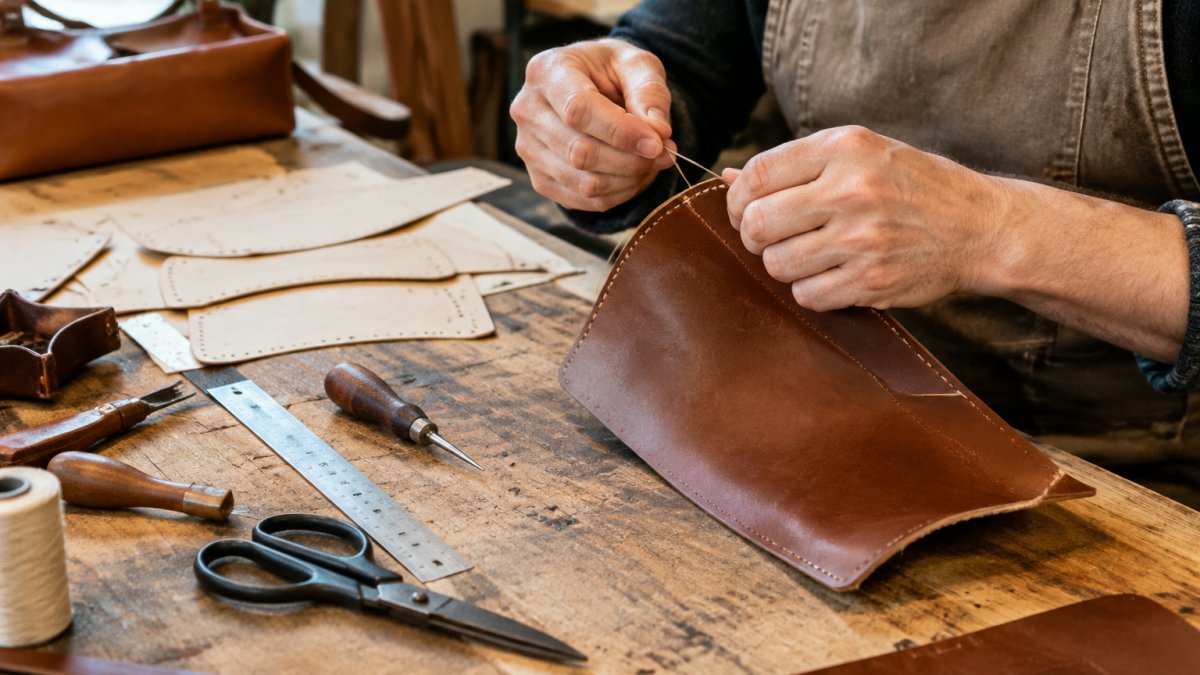
Testing is unglamorous and essential. Load the sample with the items from the brief. Carry it for a week. Open and close the closure two hundred times. Hang it by one strap. Check whether the base holds its shape when set down and whether the lining catches at the opening.
Revise, then sample again. Two rounds is common; three is not unusual for a complex design. For a deeper look at how handcrafted leather holds up over time, our guide on how durable handcrafted leather bags are covers what to expect.
Knowing how to design a bag and get it made means understanding the build sequence, whether you sew it yourself or work with a maker. The order matters:
Handcrafted in the USA is one of the things that sets Darling and Company bags apart, and each piece is made with attention to detail.
The wider market reflects real appetite for this. Future Market Insights' luxury handbag forecast projects the luxury segment growing from $28.9 billion in 2026 to $52.8 billion by 2036. Buyers are paying attention to provenance, not just logos.
For a practical walkthrough of what to look for and where to buy, our buyer's guide to handcrafted leather goods covers the questions worth asking before you commit. And if you are weighing the investment, our guide on why handcrafted accessories are worth it lays out the case.
A bag designed this way carries a point of view. Darling and Company builds each piece as a statement, handcrafted in the USA, with slight variations that make every bag its own. Customers have described their bags as conversation starters, works of art, and more than a bag. Each side carries a different design, so one bag reads as two.
If you have been waiting for an accessory that matches your ambition rather than blending in, this is the collection to explore. Browse the full range of artisan handbags that stand out and find the one that starts your next conversation.
The hard part of handcrafted bag design is not the sketch. It is holding every decision, from the brief to the final stitch, to the same standard. Darling and Company designs and handcrafts statement bags in the USA, treats each piece as functionally artistic wearable art, and blends current trends with enduring archetypes so the bag still feels right years from now. Get started with Darling and Company and carry something that starts conversations instead of following them.
A handcrafted bag design process typically moves through six stages: defining the bag's purpose and intended user, choosing a style and silhouette, sketching and drafting pattern pieces, selecting materials and hardware, building and testing a prototype, and finally cutting, sewing, and finishing the bag. Each stage feeds the next, so a change in proportions or material usually sends you back to the pattern before construction begins. Skipping the prototype stage is the most common way makers discover fit and durability problems too late.
Timelines vary widely with complexity. A simple tote with minimal hardware can move from sketch to finished prototype in a few weeks, while a structured bag with multiple compartments, custom hardware, and a lining takes considerably longer because each revision means a new sample. The handbag prototyping process alone often involves two or three rounds of building, testing, and adjusting before a design is approved. Costing labor and materials realistically at the start keeps the schedule honest rather than optimistic.
Mass-produced bags are built on assembly lines where each worker repeats one operation across thousands of identical units. Artisan construction keeps more of the process in fewer hands, so the maker adjusts stitching, edge finishing, and hardware placement piece by piece. That approach produces slight variations between bags, which is why handcrafted pieces are often described as one of a kind. The trade-off is time: an artisan bag takes hours of skilled labor that a factory line compresses into minutes.
Darling and Company bags are designed and handcrafted in the USA, with slight variations that make each piece unique. For collectors who value handcrafted quality and intricate design details, that craftsmanship is the core of what the brand offers.


